The Bride Has Come of Age (Part 1)
Introduction
Anyone who looks into Church history will soon discover how incredibly complex and multi-faceted it is. Yet the astute disciple will readily notice pivotal times in her past, moments often accompanied by costly upheaval and social reform that became defining periods in her journey to where she is today. From the early missional movement chronicled in the Acts of the Apostles, as the Gospel of the Kingdom began its advance to the “ends of the earth”[1], the timeline of the Church has been delineated by historical landmarks epitomising key stages in her saga. Like the various councils of the early church fathers who contended for the faith and defence of Truth against many heresies, their rulings consequently formulated much foundational doctrine to influence church dogma for the next two millennia. But it would be wrong to think the church always got it right or has been above reproach. Sadly there are far too many occasions when the practice of the institutional church grossly failed to exhibit the nature of the Saviour it professed, and rather than a light to the world became enshrouded in sinister darkness. Yet behind the ecclesial veneer persisted a remnant whose testimony of faith, hope and love pierce through the doleful pages of church history to reassure us the Holy Spirit has always been present where He has been welcome.
It would take many volumes to document a comprehensive account of church history since the ascension of Christ, but to provide a very simplistic overview, the following timeline will help to identify some of these key moments or transitional periods.
Basic Overview of Church History
1st Century
Pentecost (c. AD 30)
The outpouring of the Holy Spirit at Pentecost (Acts 1–2) marked the commissioning of an empowered community, called to carry the message of the risen Christ to the nations. The Bride was baptised with fire—marked by purity, power, and purpose. The apostles began preaching the Gospel with boldness, leading to the rapid growth and expansion of the early Church throughout the Roman Empire. This foundational era established the apostolic witness and laid the doctrinal groundwork upon which the rest of Church history would build.
2nd Century
Expansion & Martyrdom
As the original apostles passed away, early Church leaders such as Ignatius of Antioch (c. 35–107), Polycarp (c. 69–155), and Irenaeus (c. 130–202) rose to preserve and defend apostolic teaching. Their writings became vital in countering emerging heresies, particularly Gnosticism[2]. During this period, the Gospel continued to spread beyond its Jewish roots into the Gentile world, even as the Church faced sporadic but severe persecution under Roman authorities. These trials tested the faith and endurance of believers, forging a deeper sense of identity through suffering. The blood of the martyrs became the seed of the Church, and her faithful witness under fire gave rise to astounding spiritual resilience.
3rd Century
Theological Development Amid Persecution
Under intensified persecution by Roman emperors such as Decius (reigned 249–251) and Valerian (reigned 253–260), the Church faced increasing external pressure whilst undergoing internal purification. During this turbulent time, Church Fathers like Tertullian (c. 155–220) and Origen (c. 184–253) made substantial contributions to theology, apologetics, and the interpretation of Scripture. Their writings laid foundational groundwork for Christian doctrine and helped articulate a Christian worldview amidst hostility. The concept of martyrdom as martyria—a sacrificial witness to Christ—became deeply embedded in the Church’s identity, forging the Bride through suffering and cultivating a resilient, uncompromising faith.
4th and 5th Century
Constantine & the Council of Nicaea (AD 325)
The conversion of Emperor Constantine (c. 272–337) and the Edict of Milan (AD 313)[3] marked a seismic shift in Church history. For the first time, Christianity became a legal, publicly accepted faith, ending centuries of Roman persecution. In AD 325, Constantine convened the First Council of Nicaea to confront the Arian heresy, which denied the full divinity of Christ. The Council affirmed the doctrine of the Trinity and the eternal Sonship of Christ, laying the foundation for orthodox belief for generations. This era marks the beginning of Imperial Christianity[4], as the Church enters a new chapter of global influence. However, this newfound alliance between Church and State brought both opportunities and dangers. Whilst some welcomed legitimacy and protection, others warned of spiritual compromise and decline.
The Rise of the Desert Fathers: A Call to Holiness Apart from Empire
In reaction to the increasing institutionalism and entanglement with political power, a movement arose among those yearning for purity and simplicity of faith. Figures such as Anthony of Egypt[5] (c. 251–356) and Macarius of Egypt (c. 300–391) withdrew into the wilderness to pursue lives of radical discipleship, prayer, and asceticism. These Desert Fathers and Mothers formed monastic communities that prioritised intimacy with God over imperial privilege. Their lives became a prophetic counterpoint to the imperial Church, calling the Bride back to holiness, humility, and undivided devotion.
Celtic Christianity
In the wake of Rome’s demise and the fragmentation of Western Europe, a distinct expression of Christianity emerged in the British Isles. Celtic Christianity, rooted in monastic simplicity, reverence for creation, and Trinitarian mysticism, flourished largely outside the control of the Roman Church. Saint Patrick (c. 385–461), a former slave turned missionary, was instrumental in evangelising Ireland in the 5th century, catalysing a vibrant and indigenous Christian movement. This stream of faith, centred around monastic communities, radiated spiritual vitality and missionary zeal, thriving on the margins of empire and carrying the Gospel into Scotland, Wales, and northern Europe through figures like Columba (521–597) and Aidan of Lindisfarne (d. 651).
The Fall of Rome and the Council of Chalcedon (AD 451)
As the Western Roman Empire crumbled—culminating in its fall in AD 476—the Church emerged as a vital stabilising force in the chaos. In the midst of doctrinal disputes, the Council of Chalcedon (AD 451) was convened, affirming the truth that Jesus Christ is both fully God and fully man in one person without confusion or division.[6] This became a cornerstone of orthodox Christology. Meanwhile, towering theologians like Augustine of Hippo (354–430) articulated enduring doctrines on grace, original sin, and the nature of the Church, leaving a legacy that would define Western Christianity for centuries to come.
6th Century
Rise of Monasticism and Global Expressions of the Faith
In the aftermath of the Western Roman Empire’s collapse, monasticism emerged as a vital lifeline for the Church. In Western Europe, figures like Benedict of Nursia (c. 480–547) established the Rule of Saint Benedict, a structured way of life grounded in prayer, manual labour, study, and community. Benedictine monasteries became spiritual sanctuaries and cultural strongholds—preserving Scripture, classical learning, and Christian witness throughout the so-called “Dark Ages.”
Yet the life of the Church in the 6th century was not confined to the Latin West. Christianity was already thriving in diverse, decentralised forms across the known world, each contributing uniquely to the Body of Christ:
- In Britain and Ireland, the Celtic Church, shaped by earlier missions such as that of Saint Patrick (c. 385–461), had developed independently of Roman oversight. Celtic communities were active in mission, sending monks across the British Isles and into Europe with the Gospel.
- In Africa, the Church in Egypt, Ethiopia, and North Africa continued to be a vibrant centre of theology and monastic life. The Desert Fathers and Mothers, whose influence began in earlier centuries, remained foundational to Christian spirituality. In Ethiopia, the Tewahedo Orthodox Church preserved a unique expression of Christianity with deep Jewish roots, distinctive liturgy, and Scriptural fidelity.
- In Asia, particularly in Persia (modern-day Iran and Iraq) and eastward, the Church of the East (often called Nestorian) had established itself as a significant Christian presence, reaching as far as India, Central Asia, and even China through missionary trade routes like the Silk Road. These believers remained largely independent of the Roman Church, enduring persecution yet persevering in spreading the Gospel.
- Meanwhile, in Rome, Pope Gregory the Great (c. 540–604) saw the growing division of Europe as an opportunity for mission. In AD 597, he sent Augustine of Canterbury to evangelise Anglo-Saxon England, initiating the Gregorian Mission. This outreach extended through men like Mellitus, Justus, and Paulinus, who established sees (seats of religious authority) in London, Rochester, and York. Yet when they arrived, they encountered a well-established Celtic Christianity, showing the Gospel had already taken root long before Rome’s intervention.
Thus, the 6th century whilst a time of decline and survival—was also a time of spiritual vitality across continents, with multiple streams of Christian expression flowing beyond the reach of Roman control. Whether in the forests of Ireland, the deserts of Egypt, the mountains of Ethiopia, or the trade routes of Asia, the Bride of Christ continued to grow and carry the light of Christ into new frontiers.
8th Century
Evangelism and Empire: Boniface, Charlemagne, and the Church-State Alliance
The 8th century saw significant missionary efforts that expanded Christianity beyond European borders into Africa and Asia. Boniface (c. 675–754), the Apostle to the Germans, played a key role in evangelising the Germanic tribes of central Europe. Supported by the papacy, Boniface’s efforts established Christian communities among the Saxons and Franks, forging ecclesial bonds in what would become the heart of Christianity.
Charlemagne (c. 747–814), crowned Emperor of the Romans by Pope Leo III on Christmas Day, AD 800, oversaw the expansion of Christianity across Europe. His reign marked a period of religious reform, with an emphasis on education, monastic revival, and the promotion of Christian teaching through missionary work. Charlemagne’s rule represented a growing fusion of Church and state (Imperial Church), with the emperor playing a key role in religious affairs. Whilst this alliance expanded Christianity’s influence across Europe, it also began to set future struggles between papal authority and secular power.
Whilst Europe saw dramatic growth, Christianity was also spreading in Africa and Asia. In North Africa, Berber missionaries continued their efforts to convert indigenous African groups to Christianity, despite the growing influence of Islam in the region. The Kingdom of Aksum in Ethiopia flourished during the 8th century, with the Ethiopian Orthodox Church remaining a stronghold of Christian faith in the Horn of Africa.
In Asia, the Syriac Church, active in Persia and India, maintained a long history of Christianity through its missionary networks. Known as Nestorian missionaries, they ventured into Central Asia, China, and beyond, establishing enduring communities. Notably, in 635 AD, the Tang dynasty Emperor Taizong officially welcomed Christian missionaries led by Alopen, marking the beginning of a brief period of flourishing Christianity in China during the Tang dynasty. This would continue in some regions until the rise of the Mongol Empire.
The 8th century was a time of vast evangelistic expansion, but it also marked growing tensions between the Church and political power. Charlemagne’s reign, whilst extending Christianity across Europe, saw a merging of ecclesiastical and secular authority that would lead to future struggles over papal power and secular interference in religious matters. Christianity became both a spiritual and civilising force in Europe, but the union of cross and crown sowed seeds of spiritual compromise.
11th Century
The Great Schism (AD 1054)
The formal split between the Eastern (Orthodox) and Western (Roman Catholic) Churches in 1054 was a tragic but significant development in Church history. This division, whilst painful, exposed deep theological, cultural, and political differences between the two branches of Christianity. Key points of contention included the issue of papal authority and the Filioque clause (whether the Holy Spirit proceeds just from the Father, or from the Father and the Son) in the Nicene Creed. Pope Leo IX (c. 1002–1054), who represented the Western Church, and Patriarch Michael I Cerularius (c. 1000–1059) of Constantinople, representing the Eastern Church, became the focal figures in this dispute. Their confrontation, including the mutual excommunication of each other’s representatives, formalised the split.
The Schism was not a sudden event but the culmination of centuries of growing tensions, as the two churches developed distinct liturgical practices, theological differences, and political alignments. The Western Church, under the papacy, became increasingly centralised, whilst the Eastern Church maintained a more decentralised structure with the patriarchs of various cities having significant authority. The unity of the Church was broken, and this division largely persisted for almost a thousand years, fundamentally writing the history and theology of both branches.
Despite the tragedy of the Schism, it also raised important questions about ecclesiastical authority, the nature of the Church, and doctrinal issues that would eventually pave the way for future reforms. It highlighted the need for humility and reconciliation in the Body of Christ, lessons to resonate in later centuries.
12th to 13th Century
Scholasticism & the Rise of Universities
During the 12th and 13th centuries, the intellectual life of the Church experienced a radical transformation, largely driven by scholasticism—a movement that sought to reconcile faith with reason. Anselm of Canterbury (c. 1033–1109) was an early proponent of this approach, emphasising rational arguments for the existence of God and developing the concept of matching faith with understanding. His works laid the groundwork for later theologians to engage with philosophy and theology in a systematic way.
In the 13th century, Thomas Aquinas (c. 1225–1274), perhaps the most influential figure of this intellectual tradition, brought scholasticism to its peak. His Summa Theologica sought to harmonise Christian doctrine with the philosophy of Aristotle, forming the foundation for much of Catholic theology. Aquinas’ integration of faith and reason became a central tenet in medieval Christian thought, greatly influencing the Church’s teachings and the intellectual framework of Europe.
As intellectual study flourished, so too did the rise of universities in cities across Europe e.g. Paris, Bologna, and Oxford. These institutions became centres of theological and philosophical study, providing a foundation for the renewal of thought and the dissemination of theological ideas. The establishment of universities during this period was pivotal in shaping Christian doctrine, providing a formal structure for educating clergy and laypeople alike in theology and philosophy.
At the same time, however, the growing institutional power of the Church led to tensions. The Church became a dominant political force in medieval society, yet its increasing wealth and authority often overshadowed its spiritual mission. In the 13th century, the Inquisition (a means of cleansing the church from supposed heresy) was established and dissenting voices within the Church were increasingly silenced in the name of orthodoxy and unity. Yet, amidst the institutional challenges, figures like Francis of Assisi (c. 1182–1226) emerged as radical reformers, embodying a Gospel-centred life that sought to return to the simplicity and poverty of Christ.
The 12th and 13th centuries were, therefore, a time of intellectual development, but also of tension and corruption within the Church. Whilst the intellectual achievements of scholasticism sought to bring reason into harmony with faith, the Church’s growing power and complexity often obscured the radical simplicity of the Gospel message.
14th Century
Crisis and the Seeds of Reform
The 14th century was marked by much upheaval across Europe, Asia and Africa. The Black Death (1347–1351) devastated the population, killing an estimated 75 to 200 million people (in Europe a possible half of the population perished) shaking confidence in the institutional Church (as clergy died in large numbers and prayers seemed ineffective). At the same time, the Avignon Papacy (1309–1377), where popes resided in France under political pressure, and the ensuing Western Schism (1378–1417), when multiple claimants to the papacy brought division, severely damaged the Church’s moral and spiritual authority.
In was during this chaos, early reformers emerged. John Wycliffe (c. 1320s–1384) in England denounced clerical corruption, emphasised the authority of Scripture over Church tradition, and translated the Bible into English—making God’s Word accessible to the common people. His followers, the Lollards, carried forward his teachings despite persecution. In Bohemia, Jan Hus (c. 1372–1415) echoed Wycliffe’s calls for reform and challenged abuses in the Church. His defiance of ecclesiastical authority led to his martyrdom at the Council of Constance, planting seeds to later blossom in the Protestant Reformation.
15th Century
The Advent of the Gutenberg Bible
Around 1455, Johannes Gutenberg (c1400 – 1468) of Mainz, Germany, produced the first major book printed using movable type: the Gutenberg Bible. This technological breakthrough marked the dawn of the printing revolution and radically transformed access to the Scriptures. Previously, Bibles were painstakingly copied by hand—expensive and rare, accessible only to clergy and scholars. With the printing press, the Bible could now be mass-produced, making it more affordable and increasingly available to laypeople.
This moment prepared the way for the Reformation, empowering ordinary believers to read Scripture in their own language and laying a foundation for a more personal and inclusive faith. The legacy of this innovation continues today in the ongoing efforts to translate and distribute the Bible to unreached people groups around the world.
16th Century
The Protestant Reformation (AD 1517 onward)
Then shortly after Gutenberg came the protestant reformation in the 16th century which finally rendered a break away from Catholic Rome and established the Bible as the sole authority for all matters of faith and conduct with the sacrosanct doctrine of salvation entirely a work of God’s grace through the confession and belief in the person of Jesus Christ.
Dissatisfied with Pope Clement VII refusal to consent to his divorce, it was King Henry VIII who led the way for the Reformation in England, founding the Church of England to legitimise the annulment of his marriage to Catherine of Aragon in 1533 in order to marry Anne Boleyn in the hope of siring a male heir to the throne. The events of his life and six wives are well documented, but the reason I mention this tumultuous time is because it was part of another defining season that would set the course of church history on a trajectory eventually culminating in the life and death of Queen Elizabeth II in 2022. I’ll share more about her prophetic significance in the next chapter, but we’ll end our brief tour through Church History here and share why all this is significant for the Bride today.
The Bride Has Come of Age
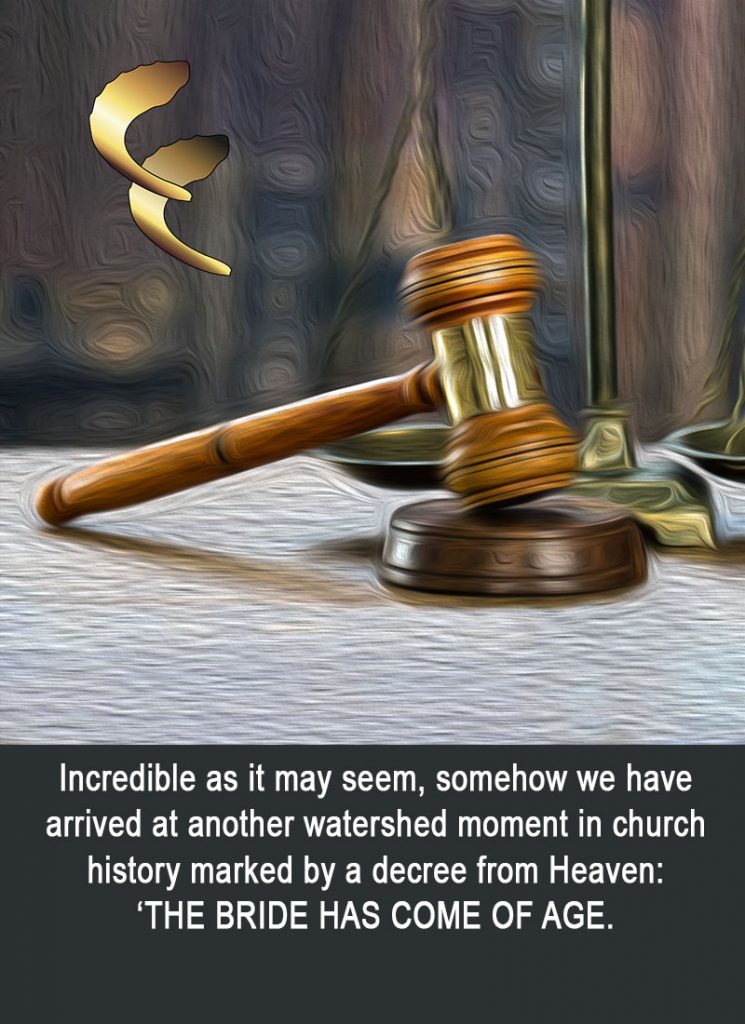
I’ve provided this overview of Church history to catch a glimpse of the Bride’s journey over the past two thousand years. This macro perspective helps condense the expanse of time and demonstrate we are part of an incredible story—one with many chapters along the way. And now, we are living a new chapter, prophetically signposted for those who have eyes to see and ears to hear. The most remarkable season of our entire history is upon us. From the highest court in Heaven, it has been decreed:
“THE BRIDE HAS COME OF AGE.”
Although the writing has been on the ecclesiastical wall for many years, this moment has crept into view quite unexpectedly. Yet, in the foreknowledge of the Heavenly Father, this day was determined and written down long before the first dawn cast its light upon a sinless world. As we shall see, the implications of this decree are far-reaching.
This watershed moment urges the Bride to arise and sets the spiritual climate across the nations of the world. My aim here is not to become bogged down in the complexities of our past, but to draw out the prophetic significance of our history and how it has brought us to where we are today. Regardless of our location, national history, or denominational background, the Bride shares a common spiritual identity. Looking through the Bridal lens allows us to see beyond geography, politics, and human institutions to discern the spiritual reality that transcends the natural realm.
The historical record is an indication of what is taking place in the unseen realm. In this way, history becomes a gateway to discern the spiritual development of the Bride.
Of course, each nation has its own story and defining moments to tell—times of receptivity or resistant to the gospel—periods of persecution, compromise or flourishing. Yet amid this diversity, the Church is united in one identity. She transcends history and geopolitical divides. As Paul reminds the Ephesians:
“(4) There is one body and one Spirit, just as you were called in one hope of your calling; (5) one Lord, one faith, one baptism; (6) one God and Father of all, who is above all, and through all, and in you all.”
Ephesians 4:4-6 NKJV
In short, all of Church history has brought us through the millennia with a remarkable testament to the faithfulness and provision of God. Despite seasons of darkness and apostasy, He has brought renewal, reformation, revival, and refreshing. And now, somehow, we have arrived in the 21st century at this extraordinary moment Heaven is declaring:
“THE BRIDE HAS COME OF AGE.”
Whatever has gone before must now give way to what lies ahead. The reality confronting the Church is both climactic and glorious: beyond her expectation, beyond her merit, she is betrothed to her Bridegroom and destined for the ultimate wedding—the Wedding of the Lamb. She will be adorned for her Husband, without spot or wrinkle, prepared in love and faithfulness. The overarching question we must therefore ask, is not if this day will come, but will we be ready for it when it does? For whilst the Church awakes to her Bridal identity, the prophetic timeline of God’s eternal purpose continues to tick unabated.
Selah
Principles
- The historical record is an indication of something taking place in the unseen realm. In this way, history presents a gateway to discern the spiritual development of the Bride.
- We have reached a watershed moment in the journey of the church. Heaven decrees: “The Bride has come of age”.
Scriptures
“(11) And do this, knowing the time, that now it is high time to awake out of sleep; for now our salvation is nearer than when we first believed. (12) The night is far spent, the day is at hand. Therefore let us cast off the works of darkness, and let us put on the armour of light. (13) Let us walk properly, as in the day, not in revelry and drunkenness, not in lewdness and lust, not in strife and envy. (14) But put on the Lord Jesus Christ, and make no provision for the flesh, to fulfil its lusts.” Romans 13:11-14 NKJV
“(7) “Let us be glad and rejoice and give Him glory, for the marriage of the Lamb has come, and His wife has made herself ready.” (8) And to her it was granted to be arrayed in fine linen, clean and bright, for the fine linen is the righteous acts of the saints.” Revelation 19:7-8 NKJV
Quotes
“God bears his people through all their darkness, suffering, and waiting until they come to themselves and find their hope in Him alone.”—Dietrich Bonhoeffer, Letters and Papers from Prison, 1943–1945
“All shall be well, and all shall be well, and all manner of thing shall be well.”—Julian of Norwich, Revelations of Divine Love
“In the evening of this life, we shall be judged on love alone.”
—St John of the Cross, The Ascent of Mount Carmel
Pause for Reflection
- What lessons can I learn about the faithfulness and sovereignty of God through the ages, and how does this give me hope for the season we are now in?
- If the church cannot remain where she has been, what are the implications for my life and ministry?
- How is the Church, as the Bride, being purified today? In what ways is God using trials, struggles, or seasons of difficulty to purify her?
A Prayer of Thanksgiving
Our Heavenly Father, the Eternal God of the ages, we come before You today with hearts full of gratitude and awe. You, who are the Beginning and End have been faithful throughout the ages. From the creation of the world to the unfolding of all Church history, You have watched over the Bride for Your Son, guiding her, refining her, and preparing her for the glorious day of His return.
Lord Jesus, we cry out with the Spirit and the Bride: “Come!” Our hearts long for the day when we will be united with You, pure and without spot, at the wedding of the Lamb. Help us to live in readiness, casting off darkness and walking in the light of Your truth. Awaken our hearts to Your coming and make us faithful in this hour. May we grow in grace and live in the hope of Your return, eagerly awaiting the day when we will see You face to face.
Maranatha
Amen.
[1] Acts 1:8
[2] Gnosticism refers to a range of early religious and philosophical movements (1st–3rd centuries AD) that taught salvation came through gnōsis—secret or superior knowledge—rather than through faith, repentance, and participation in the life of Christ. Gnostic systems typically regarded the material world as flawed or evil and often attributed its creation to a lesser deity (demiurge), in contrast to the true, hidden God. The early Church decisively rejected Gnosticism for denying the goodness of creation and the full incarnation of Christ, most notably through the work of Irenaeus of Lyons in Against Heresies (c. AD 180), which defended the apostolic faith and the embodied, redemptive work of Christ handed down through the Church.
[3] The Edict of Milan (AD 313) was a proclamation issued by the Roman emperors Constantine and Licinius granting legal toleration to Christianity throughout the Roman Empire. It ended state-sponsored persecution of Christians and restored confiscated church property. While the edict did not make Christianity the state religion, it marked a decisive shift in the Church’s relationship with political power, moving the Christian faith from the margins of society into imperial favour—a transition that profoundly shaped the subsequent history, structure, and self-understanding of the Church.
[4] Imperial Christianity refers to the form of Christianity that emerged after the Church gained legal status and imperial favour in the Roman Empire, particularly following the Edict of Milan (AD 313). As Christianity became increasingly aligned with political power and state structures, the Church’s identity, priorities, and modes of influence were reshaped. Whilst this period enabled the widespread establishment of Christian institutions and doctrine, it also introduced tensions between the Church’s calling as a distinct, cruciform people and its new role within imperial systems—tensions that have continued to influence Christian history and theology.
[5] Anthony of Egypt, often called the Father of Monasticism, was an early Christian ascetic whose withdrawal into the Egyptian desert profoundly influenced the development of Christian monastic life. Although Anthony himself lived primarily as a hermit, his radical pursuit of holiness inspired others to gather around him, forming loose but recognisable ascetic communities. His life, recorded in The Life of Anthony by Athanasius of Alexandria, became one of the most influential spiritual texts of late antiquity, catalysing the spread of monasticism across Egypt, Palestine, and eventually the wider Christian world.
[6] The doctrinal statement, known as the Chalcedonian Definition reads in part:
“Following the holy Fathers, we all with one voice teach that the Son, our Lord Jesus Christ, is to be confessed one and the same Son, perfect in Godhead and perfect in manhood, truly God and truly man… acknowledged in two natures, without confusion, without change, without division, without separation; the distinction of natures being by no means taken away by the union, but rather the properties of each nature being preserved, and concurring in one Person and one Subsistence.”
— The Definition of Chalcedon (AD 451)