Reflection and 2026 Prophetic Direction – Part 2
Previously, I shared about the necessity of winter — not only as a personal reality, but as a lens through which we might discern where the Church herself has arrived. I suggested that what was once vibrant and colourful must sometimes be allowed to fall away and die because winter brings the opportunity for transition. In that reflection, I laid some important groundwork: what the Lord has chiselled in hiddenness requires a different lens to recognise; the gestation of Divine Will cannot be hurried by the urgency of the day; and our recalibration is not toward greater activity but toward identity, stillness, and union.
Prophecy resonates with identity — what we hear and accept aligns with how we view ourselves. That said, until the Church embraces her Bridal identity, she remains vulnerable to a multitude of prophetic voices compelling her along pathways she may not be called to walk, and so the divided trajectories upon which she now travels will continue. The urgency of the hour is more about identity than it is about enterprise.
The pressing question is not what we should do but who we believe ourselves to be.
That’s why the Call2Come prophetic lens is not primarily concerned with what the Church should undertake next, but who she must become now. Our mandate exists to serve this need: to romance the Bride, lead her toward the Bridegroom, and prepare her for His return. This calls for prophets who, like John the Baptist in the spirit of Elijah, first understand themselves as friends of the Bridegroom. Such a calling does not negate in any way the earnest cry for the Great Commission neither does it diminish the essential partnership of apostle, evangelist, pastor, and teacher, yet it honours the unique responsibility of the prophet, who speaks having first stood before the Lord in His council.
As we step into 2026, many “prophetic words” will call for action, advance and conquest, others will appeal for reform and restitution. While some of these words may be sincere, the reality is that most will not flow from the Bridal vantage point or chamber. Yet without this Divine order of identity, stillness, and union, even sincere words can mask the destiny she must fulfil in preparing the way of the Lord. That’s because mission reproduces its own kind. We replicate who we are.
Without Bridal transformation at the very core of how we think and live, we risk being no further forward in preparing for His return — since it is for His Bride that He is coming.
It is from this lens that I want to share what I believe the Lord is showing for 2026, and how the Bride is to move in step with Him in the year ahead.
We need a governmental realignment, yet such calibration is not first toward mission but toward identity.
Until we undergo the transformation that embracing our Bridal identity brings, we are unable to walk the straight line our destiny requires.
Instead, we risk further delay, circling the proverbial mountain of reformation and reset once again. Here is the crux: this paradigm shift requires stillness, not activity. More than that, if we are to move forward in step with the Lord rather than driven by speculative ambition not matter how well intentioned, we must relinquish our reliance on knowing Him by reason or the faculties of the soul, and consent instead to the mystery that lies beyond them — for it is there that His throne is encountered and where bridal union is found. This mystical tradition weaves its way through church history and is firmly grounded in Scripture. It has always held this tension: God reveals Himself, yet He can never be fully known. His ways are higher than our ways; His thoughts transcend our own. To truly know God is to accept that He remains beyond comprehension, yet His self-revelation draws us beyond certainty into mystery. If this is so, then knowing God as we believe we may, is not the end of the encounter but its beginning.
Knowledge brings us to the mountain of God, but unknowing enables us to ascend. And it is here that we have arrived.
We see this movement from knowing to mystery when the Lord called Moses to ascend Mount Sinai. In the Exodus account, God revealed Himself to Moses as I AM WHO I AM and brought His Bride out of Egypt with great power and an outstretched arm, leading her to the foot of the mountain. He made Himself known in ways unparalleled in Scripture — through signs and wonders, and through the pillar of cloud by day and fire by night. Yet even these revelations did not contain Him. The One who could be followed and named could not be comprehended or possessed. As Moses ascended, he entered the gloom and darkness covering the mountain, and the psalmist later reflects — God has made darkness His dwelling place. The journey that began with visible deliverance now required trust in hiddenness.
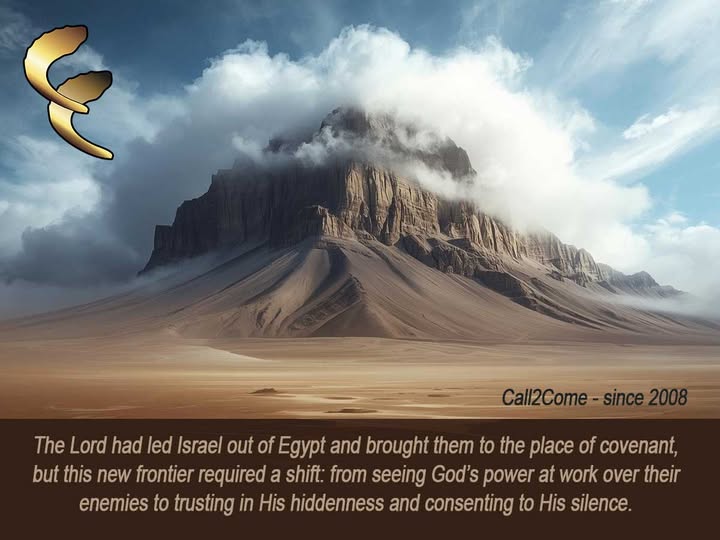
While Moses remained in this “cloud of unknowing”, the Bible recalls “when the people saw that Moses delayed coming down from the mountain, the people gathered together to Aaron, and said to him, “Come, make us gods that shall go before us; for as for this Moses, the man who brought us up out of the land of Egypt, we do not know what has become of him.”” Exodus 32:1. There is a restlessness within the soul that compels striving and calls for action, and in their impatience they entreated Aaron to make them gods to go before them. The Lord had led Israel out of Egypt and brought them to the place of covenant, but this new frontier required a shift: from seeing God’s power at work over their enemies to trusting in His hiddenness and consenting to His silence.
Not because He had abandoned them but because the protocols of silence preceding government, and identity coming before mission, were being chiselled by His Almighty hand on tablets of stone.
Aaron fashioned the golden calf from the earrings of the people — earrings that were not incidental but marked their divine adornment and belonging (Exodus 32:2). To remove them was a collective act of re-identification. Gold that had once signified their bridal identity was melted into something visible, tangible, and idolatrous. Here we see the danger at the threshold of unknowing:
When knowing does not yield to silence, even God’s gifts can be idolised. The calf is born where silence is refused. Idolatry results when revelation about God replaces relationship with Him.
This pivotal moment at Sinai exposes a critical principle for the Bride as we transition into the new year: the government of God cannot be grasped through what we believe we have already seen, understood, or mastered.
His rule is transcendent. It flows through posture and relational alignment.
And so true preparation for what lies ahead begins in stillness, for silence precedes government — even when the people around us clamour for immediacy, visibility, and action.
In the next part of this prophetic direction, I will unpack how these principles apply directly to the Bride in 2026, where the present danger lies, and how Call2Come is positioning itself to steward its mandate in the days ahead. Until then, let us ascend the hill of the Lord with clean hands and a pure heart.
Mike
Call2Come
#GoldenCalf #idolatry #Prophecy2026 #call2come #mountsinai