The Consecrated Bride (Part 2)
Introduction
We have explored the necessity of being set apart, highlighting accession requires consecration, because authority without purity is dangerous. To be consecrated is to be wholly dedicated unto the Lord, disentangled from every unholy alliance that once compromised the Bride’s devotion and stole her prophetic voice. We examined Israel’s tragic decline rooted in her adulterous and wayward heart that led her to mingle with foreign nations and bow to their gods. The consequences for Israel were severe yet the same warnings that applied then still speak directly to the Bride today. Make no mistake, whilst the act of building an altar to Baal may seem antiquated and relegated to the pages of the Old Testament, the sin of idolatry remains—albeit under a different guise. The Bride must carefully navigate her pilgrimage through many cultural and spiritual threats if she is to live in the world yet not be of it. She must be vigilant and pursue the sanctification that awaits in the desert. This is where she can hear her Beloved’s still small voice without the clamour of competing affections. Without such devotion she is easily estranged from the Bridegroom and unequally yoked to another. Political alliances that compromise Kingdom values, theological concessions that dilute truth, and partnerships that prioritise unity over holiness, all become snares for the Bride to avoid.
Throughout this book, we’ve seen how the Bride has come of age. She has matured under the tutelage of guardians—those entrusted throughout history to care for her spiritual formation. From generation to generation, she has learned their language, adopted their faith, and inherited their understanding of Scripture. Their influence was had purpose, for in God’s providence they played a role in her early development. Yet now a fresh challenge arises—one that strikes at the very core of her identity.
For although the Bride has come of age, she is far from possessing all the answers. In truth, she enters this moment confused and uncertain—unsure of who she is, what she believes, or where she belongs in the world.
Her upbringing has scarcely prepared her for the weight of the mantle she must now embrace. As we shall learn, the Bride cannot rely upon all she has been told and if she is to stand on her own two feet, she must quickly learn to think for herself and know her own mind. This then is our objective here. The last chapter introduced the consecration of the heart, here we shall see why the Consecration of the mind is of equal importance.
Some Helpful Definitions
We will find the following definitions helpful:
Eschatology “is the study of the future, the last things—death, judgment, heaven, and hell, along with Christ’s return and the final state of God’s kingdom. It tells us how the story ends, so we know how to live now.”
—J.I. Packer (Concise Theology)
Missiologyis the study of how we share the message of Jesus across different cultures and contexts. It’s rooted in the Great Commission, where Jesus commanded, “Go into all the world and preach the gospel to all creation”[1]. At its heart, missiology asks how we can faithfully communicate the gospel in ways true to Scripture and meaningful to those we’re reaching.
Hermeneutics “explores how we read, understand, and handle texts, especially those written in another time or in a context of life different from our own. Biblical hermeneutics investigates more specifically how we read, understand, apply, and respond to biblical texts.”
—Anthony C. Thiselton (Hermeneutics: An Introduction)
Guardians – In the context of this chapter, the term guardian is not used negatively, but to refer to the custodians of the Bride before she came of age. They include Church Fathers, Reformers, theologians, denominations, and influential movements throughout history who channelled the Bride’s understanding of Scripture through their own interpretive lens.
Learning From History
Understanding the journey the Bride has taken is essential if we are to discern where she now stands, and what lessons she must carry forward. Both Old and New Testament scriptures encourage us to learn from the past, to listen to the voices of former generations and gain wisdom from their experience:
“(8) “For inquire, please, of the former age, And consider the things discovered by their fathers; (9) For we were born yesterday, and know nothing, Because our days on earth are a shadow. (10) Will they not teach you and tell you, And utter words from their heart?” Job 8:8-10 NKJV
“(11) Now all these things happened to them as examples, and they were written for our admonition, upon whom the ends of the ages have come. (12) Therefore let him who thinks he stands take heed lest he fall.”
1 Corinthians 10:11-12 NKJV
Without a knowledge of history, we remain blind to our present condition.
As Martin Luther King Jr. once said, “We are not makers of history. We are made by history.” And Winston Churchill famously warned, “Those that fail to learn from history are doomed to repeat it.”
To better understand how the Bride’s mind has been influenced over time, we need some awareness of the beliefs her guardians championed through the ages. These were not fixed positions but adapted and evolved as each generation sought to reconcile the cultural and socio-political climate of their time with the enduring yet historically written Word of God. This process of seeking relevance is what we mean by hermeneutics—the method by which Scripture could be re-interpreted and future hope envisaged.
Whilst historians have identified numerous epochs along the Church’s historical timeline, for our purposes, we will trace the shifts in millennial conviction as a simplified and useful delineator.
“(4) Then I saw thrones, and seated on them were those to whom the authority to judge was committed. Also I saw the souls of those who had been beheaded for the testimony of Jesus and for the word of God, and those who had not worshiped the beast or its image and had not received its mark on their foreheads or their hands. They came to life and reigned with Christ for a thousand years. (5) The rest of the dead did not come to life until the thousand years were ended. This is the first resurrection. (6) Blessed and holy is the one who shares in the first resurrection! Over such the second death has no power, but they will be priests of God and of Christ, and they will reign with him for a thousand years.” Revelation 20:4-6 ESV
Premillennialism – A Theology of Hope and Preparation for Jesus’ Return
Understanding the beliefs and practices of the earliest Church is important because of their chronological proximity to Jesus and the apostles. The closer a source is to the time of the events it describes, the more likely it is to preserve authentic teaching and intention. These early Christians lived within the cultural, linguistic, and historical context of the New Testament, and many were either direct disciples of the apostles or their immediate successors. Their nearness in time lends their writing a unique authority, offering valuable insight into what the first disciples believed.
In the first two centuries A.D., Christians living under the threat of Roman persecution held a predominantly premillennial view—that Christ would soon return, overthrow evil, and inaugurate a literal thousand-year reign. This eschatological hope sustained the persecuted Church. It was a theology of endurance, marked by patient longing for the “restoration of all things” in the face of suffering. The Bridal cry come was captured in the Aramaic greeting Maranatha, and reflected a missiology not centred on taking dominion, but on preparing the way for the One to whom all kingdoms would ultimately yield—who alone could subdue the spread of evil by “the brightness of His coming”[2].
Church Fathers such as Papias (a disciple of John, c. 60–130 AD), Justin Martyr (an early Christian apologist, c. 100–165 AD), and Irenaeus (a disciple of Polycarp, who had himself been discipled by John, c. 130–202 AD) were all proponents of this vibrant expectation. Their teachings kept the Church watchful, prophetically relevant, and free from worldly affairs[3].
Here is what they wrote concerning the millennial reign:
Papias: “There will be a period of some thousand years after the resurrection of the dead, when the kingdom of Christ will be set up in a material form on this very earth.”—Fragments, as cited by Irenaeus, Against Heresies, 5.33.4
Justin Martyr: “I and others, who are right-minded Christians on all points, are assured that there will be a resurrection of the dead, and a thousand years in Jerusalem, which will then be built, adorned, and enlarged.”
—Dialogue with Trypho, Chapter 80
Irenaeus: “The promise of God made to Abraham remains steadfast… The righteous shall indeed rise again… and they shall reign in the renewed earth.”—Against Heresies, 5.32–36
The hermeneutic of the early Church Fathers was largely influenced by their chronological proximity to the first apostles, interpreting Scripture according to what they had received first hand.
The apostolic assignment[4] was to remain faithful stewards of the gospel as it had been delivered to them, preserving the teachings of Christ and the apostles with urgency and purity in anticipation of His imminent return. Their mission was to preach the Gospel of the Kingdom throughout the world as a witness to all the nations before the end would come[5].
Amillennialism – A Theology of Life Within Empire
One of the most defining and transformative chapters in Church history came in the fourth century, when Christianity shifted from the margins of persecution to the centre of imperial favour. With the conversion of Emperor Constantine and the Edict of Milan in 313 A.D., the Church received legal recognition and unprecedented religious freedom. At first glance, this appeared to be a divine breakthrough: persecution ceased, and previously confiscated Church properties were restored. Constantine also commissioned the construction of grand basilicas in Rome and the Holy Land, including the original St. Peter’s Basilica, the Church of the Holy Sepulchre in Jerusalem, and the Church of the Nativity in Bethlehem. The once-persecuted Church now had legal protection, imperial patronage, and magnificent cathedrals. The Bride, once found in the wilderness, now dined in the marbled courts of the Emperor.
Eusebius, a celebrated historian and theologian of the 4th century,recorded Constantine’s church planting program:
“He adorned the holy sanctuaries of God with a splendour far surpassing that of the most celebrated temples, and gave to them offerings in silver and gold and other costly gifts.” —Life of Constantine, Book 3, Chapter 30
Eusebius heralded this new age as the fulfilment of God’s kingdom on earth. He wrote:
“Thus, when their whole empire, that is, when the Roman Empire, was conquered and had yielded to the Christ of God, when, indeed, all the foes of the faith had been subdued… the princes and rulers of the earth came, and worshipped the Christ, as it was foretold.”
—Oration in Praise of Constantine, 16.1
Thus began the rise of imperial Christianity ratified later in 380 A.D. (during the reign of Emperor Theodosius I) by the Edict of Thessalonica which endorsed Christianity as the official state religion. The Bride was ascending into influence but not in the way Christ had modelled. In a union with the State, the Church gained political protection but was in danger of losing her prophetic edge. Her garments, once interwoven with sacred threads from the desert, were now embroidered with the emblems of Empire, and the intimacy of her wilderness romance exchanged for the security of imperial favour.
She was in danger of no longer being the called-out ones (ekklesia), but rather the called-in ones—absorbed into the kingdom, institutionalised, and dispersed across the vast domain of Rome.
It was leading up to and during this Imperial Church era that allegorical interpretation gained prominence. The earlier hermeneutic of chronological proximity, which had shaped the writing of the earliest Church Fathers, began to give way to a more allegorical and philosophical approach. This was partly influenced by the resurgence of Greek philosophical ideas which found a home in the intellectual halls of Alexandria, North Egypt.
Origen of Alexandria (c. 184–253 AD), a brilliant but controversial theologian, played a pivotal role in this interpretive shift. Drawing deeply from Scripture whilst also employing categories drawn from Greek philosophy[6], Origen developed a multi-layered hermeneutic that sought meaning beyond the literal—distinguishing between the literal, moral, and spiritual senses of the text. In doing so, he re-interpreted key eschatological passages, moving the Church’s expectation away from a literal, earthly millennial reign of Christ toward a more spiritualised understanding of the kingdom. Although his methods were later viewed with scepticism[7], and, in some cases, correction, they left a lasting and formative imprint on Christian thought[8].
This theological shift was consolidated further by Augustine of Hippo (354–430 A.D.), one of the most influential thinkers in Christian history. Writing in the aftermath of the sack of Rome in 410 A.D., Augustine composed his seminal work, The City of God, to provide a theological response to this collapse of the imperial capital. In it, he proposed the millennium described in Revelation 20 was not a future earthly reign but a symbolic expression of Christ’s present spiritual rule through the Church. To be clear, Augustine never advocated for a triumphant church within the pillars of society. His vision was far more nuanced. He described the Church as a pilgrim people—the City of God—journeying within and alongside the earthly city until Christ’s return.
Yet despite Augustine’s intentions[9], his millennial view became part of a broader shift in eschatological perception—one that increasingly located the Kingdom of God within the present age and the life of the Church. In the centuries that followed, this perception gathered momentum and reached a symbolic peak in 800 A.D., when Pope Leo III crowned Charlemagne as Emperor of the Romans. This act helped revive the Western Roman Empire in the form of the Holy Roman Empire and asserted the Church’s authority to legitimise earthly governance. It entangled the Bride with political power, blurring her pilgrimage in a world overlaid by empire.
Such theology served the vision of the Imperial Church well. With premillennialism largely out of the way, the Bride no longer required the return of her Bridegroom to consummate justice and righteousness because she embodied His Kingdom in the present moment—commissioned not only to witness but sanctioned to rule. And so eschatology changed from looking towards a glorious return of the Bridegroom King to a validation of the Church’s authority, wealth, and influence within the kingdom now. With this theological turn, the Bride’s voice changed. The cry of maranatha faded beneath the proclamation of a kingdom already realised, and the fervour of Bridal longing dimmed in the embrace of institution.
The hermeneutic of the Imperial Church was increasingly structured by allegory and syncretism with Greek philosophy. The chronological proximity of the early Church Fathers gave way to a more symbolic analysis aligned with a new status within the Roman Empire.
The apostolic ambition of the Imperial Church shifted from preparing the Bride for her coming King to governing the world in His name, embracing influence within empire rather than speaking prophetically outside it.
Postmillennialism – A Theology of Triumph and Reform
Emerging more clearly in the wake of the Reformation and gaining significant momentum in the 17th to 19th centuries[10],
“Postmillennialism expects that eventually the vast majority of people living will be saved. Increasing gospel success will gradually produce a time in history prior to Christ’s return in which faith, righteousness, peace, and prosperity will prevail in the affairs of men and of nations. After an extensive era of such conditions Jesus Christ will return visibly, bodily, and gloriously, to end history with the general resurrection and the final judgment after which the eternal order follows.” —Wikipedia
Unlike the persecuted Church of the early centuries or the politically entangled Church of the Roman Empire, the postmillennial vision flourished in an age of progress, discovery, and colonial expansion. Enlightenment optimism, coupled with missionary zeal, swayed belief how the world could be gradually Christianised through preaching, education, and social reform. It was thought, the kingdom of God would emerge through the faithful labour of the Church across the nations, rather than any sudden intervention of Christ Himself.
The hermeneutic of postmillennialism built upon amillennial foundations by retaining an allegorical view of Scripture. Its divergence came from the heightened optimism of historical context—the Enlightenment, missionary expansion, and belief in human progress.
The apostolic ambition of the postmillennial Church was to see the world increasingly transformed through the power of the Gospel, ushering in a church golden age upon the earth by discipling nations prior to Christ’s return.
Conclusion
We began this chapter highlighting how coming of age does not mean the Bride has arrived ready for the role accession demands of her. Instead, we have crossed this threshold with a high degree of confusion and uncertainty. This disorientation stems from a complex spiritual upbringing.
The Bride has not been raised by one guardian, but many. And these guardians, however sincere and devout, have not always spoken with one voice or shared the same beliefs.
From the Fathers to the Reformers, from mystics to modern theologians, we have inherited a diverse array of theological perspectives, many of which directly contradict one another. As we’ve seen through the lens of millennialism[11], the Bride’s journey growing up presented different hermeneutics at different times, defining eschatology and missiology within its historical context. These were the narratives of her guardians. Whilst each tradition may have served the church in its own era, the accumulated legacy has left the Bride bearing the weight of these competing doctrines, divided eschatologies, and denominational biases.
The result is theological discord—a multiple personality disorder of belief—where her heart may yearn for her Bridegroom, yet her mind is entangled with inherited confusion.
This schism cannot be healed simply by arguing for one theological system over another. Consecration of the Bride requires her heart but mind also. Having come of age, she must move beyond the paradigms of her guardians and step into the wilderness, where the voice of her Beloved will awaken the Bridal consciousness she so desperately needs. If she is to speak with clarity, authority, and prophetic precision, she must receive a new hermeneutic—not adaptive but transcendent; not reactive but revelatory; not divided but whole.
Any attempt at reformation must go further than ecumenicalism; it must challenge our corporate identity to move beyond unity and into the oneness of the Bride. We have learned the language of our guardians and inherited their legacy, but now the Bride must find her own voice. Scripture must be re-examined through a new lens—unshackled from the philosophies of men and historical contexts that influenced voices such as Origen and Augustine. The Bride must disentangle herself from centuries of accumulated doctrinal tradition.
This is not to say what we have inherited is necessarily wrong or unworthy of much appreciation—especially considering the great cost many paid in their pursuit of truth and resolute contending for the faith. That is not the point being made. We are much indebted to our forebears who, in their time, pioneered paths the Church has walked to this day. Yet there is a danger here—one the Apostle Paul identified in his letter to the Corinthians when he admonished them for aligning with men rather than Christ. Such sectarianism, he said, was carnal and led to strife: “Is Christ divided?”[12]. Sadly, the division in Corinth was a foretaste of how fragmented the Church would later become by following factions instead of the Lord.
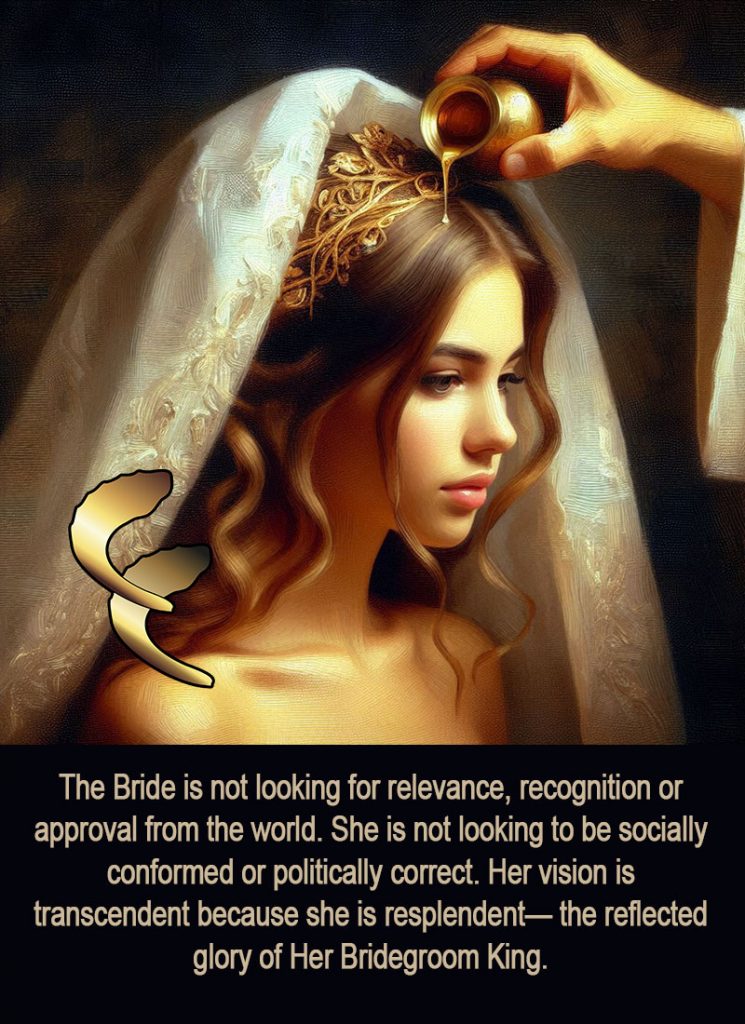
Take for example the bewildering diversity of views on rapture, predestination, cessationism[13], Israel, the Trinity, original sin, baptism, or the Great Tribulation—the list goes on. These disagreements have failed to give the Bride a clear voice or clarified vision. Revelation must be found from a different time and place, disentangled from this inherited dissonance and into the clarity found through the gaze of a heart and mind centred on Jesus as our Bridegroom King. The desert offers this gift. A new hermeneutic. One, without adaptation to culture or social-political norms, and one not driven by Kingdom centric apostolic ambition. The Bride is above looking for relevance, recognition or approval from the world—beyond social conformity, political correctness, or trading spiritual efficacy for interfaith orthodoxy. She must not become entangled in civilian affairs nor embroiled with Babylonian ambition. It is a narcissism that finds its roots in Eden, the original deception of enlightenment via a trespass of Divine boundaries. The Bride has no need of such things. Her vision must be transcendent because she is resplendent— the reflected glory of Her Bridegroom King.
To be called for such a time as this, requires not only the consecration of her heart but her mind also.
Selah
Principles
- If the Bride is to stand on her own two feet, she must quickly learn to think for herself and know her own mind.
- The principle of chronological proximity suggests the writing of the early church fathers provide an invaluable insight and authority into the beliefs of the first apostles.
- The Bride has been raised by many guardians who interpreted scripture differently—her heart may yearn for her Bridegroom, but her mind is entangled with inherited confusion.
- The desert is where the Voice of the Bridegroom will awaken Bridal consciousness.
Scriptures
“(8) “For inquire, please, of the former age, And consider the things discovered by their fathers; (9) For we were born yesterday, and know nothing, Because our days on earth are a shadow. (10) Will they not teach you and tell you, And utter words from their heart?” Job 8:8-10 NKJV
“(1) I beseech you therefore, brethren, by the mercies of God, that you present your bodies a living sacrifice, holy, acceptable to God, [which is] your reasonable service. (2) And do not be conformed to this world, but be transformed by the renewing of your mind, that you may prove what [is] that good and acceptable and perfect will of God.” Romans 12:1-2 NKJV
Quotes
“The Christian mind is not a mind that withdraws from the world; it is one that engages the world from a radically different perspective—seeing through the eyes of Christ.”
—Francis Schaeffer (The God Who Is There)
“The renewal of the mind is not a once-and-for-all experience, but a continual process of being shaped by Christ’s likeness through prayer, study of Scripture, and community.”
—Dietrich Bonhoeffer (The Cost of Discipleship)
“The renewal of the mind does not come automatically by simply spending time in God’s presence. It comes when we choose to think God’s thoughts and not the world’s thoughts.”
—A.W. Tozer (The Pursuit of God)
Pause for Reflection
- How can I discern whether the traditions I observe are truly for the Bride today?
- Are there any inherited beliefs or assumptions I need to lay down?
- Am I making the most of wilderness times in my life?
[1] Mark 16:15 NIV
[2] 2 Thessalonians 2:8
[3] “(3) You therefore must endure hardship as a good soldier of Jesus Christ. (4) No one engaged in warfare entangles himself with the affairs of [this] life, that he may please him who enlisted him as a soldier.”
2 Timothy 2:3-4 NKJV
[4] As we shall see, the apostolic assignment of the early church can mutate toward apostolic ambition in later reinterpretation of scripture
[5] Matthew 24:14
[6] Platonism experienced a significant resurgence in the early centuries of the Church, particularly through Middle Platonism and later Neoplatonism, which shaped the intellectual environment in which early Christian theologians worked. Thinkers such as Origen and Augustine of Hippo engaged deeply with Platonic philosophy, adopting its emphasis on the immaterial, eternal realm over the material world. Origen employed Platonic concepts such as the pre-existence of souls and the ascent of the intellect toward God, whilst Augustine integrated Platonic ideas of divine transcendence, illumination, and the hierarchy of being into his theology.
[7] Origen’s theological legacy, though foundational, was later approached with caution due to speculative doctrines attributed to his teaching, particularly concerning the pre-existence of souls and universal restoration. These controversies led to the condemnation of certain Origenist propositions at the Fifth Ecumenical Council (AD 553), resulting in a more guarded reception of his work, even as his exegetical influence endured.
[8] Origen’s use of Platonic language does not indicate a wholesale adoption of Platonism. He repeatedly distinguished Christian revelation from Greek philosophy and argued forcefully for the superiority of the gospel, particularly in its proclamation of the incarnation and God’s active involvement in history (Contra Celsum). Philosophy served Origen as a secondary instrument of expression, not a governing authority, even where its categories influenced his hermeneutical approach.
[9] Augustine’s interpretation of the millennium was not a call to a triumphant church. In The City of God, he presents the Church as a pilgrim people distinct from all earthly empires and resists identifying the Kingdom of God with political rule. His eschatology sought to protect the transcendence of the Kingdom from imperial ambition.
[10] John Jefferson Davis (a professor of Systematic Theology and Christian Ethics) notes that the postmillennial outlook was articulated by men like John Owen in the 17th century, Jonathan Edwards in the 18th century, and Charles Hodge in the 19th century. Davis argues that it was the dominant view in the nineteenth century but was eclipsed by the other millennial positions by the end of World War I due to the “pessimism and disillusionment engendered by wartime conditions.” – Wikipedia
[11] There is a fourth interpretation known as preterism, which holds that most eschatological passages in the Bible have already been fulfilled.
[12] 1 Corinthians 1:13
[13] Cessationism is a doctrine that spiritual gifts such as speaking in tongues, prophecy, and healing ceased with the apostolic age.