The Accession of the Bride
Introduction – A History Lesson for the Bride
There was a time in Jewish history when an existential threat loomed—not as a consequence of war, but in a deliberate act of hatred and aggression. The Book of Esther tells of a man named Haman, the vizier to the King of Persia, whose heart was consumed with pride and rage, ignited by one man: Mordecai, a Jew, who refused to bow before him. Enraged by what he perceived as dishonour, Haman did not merely seek revenge against Mordecai alone. His hatred grew into a genocidal plot, and he petitioned the king for permission to annihilate every Jew across the vast Persian Empire—from India to Cush, spanning 127 provinces. Shockingly, his malevolent proposal was granted and a royal decree issued to destroy the entire Jewish population—all because one man, Mordecai refused to bow and pay Haman the respect he craved.
Yet despite his cunning, Haman failed to see how God had already positioned someone within the royal court for such a time as this. Esther, a young Jewish woman, raised in obscurity by her cousin Mordecai after the death of her parents, now lived within the palace. Up until this point, her Jewish identity had been concealed and she was known only by her Persian name. But Esther had another—Hadassah[1] meaning myrtle, a symbol of hope and restoration.
As a girl she was raised by Mordecai an exile from Jerusalem[2]. But Esther became a beautiful young woman, noticed by none other than the King of Persia and was crowned as his queen. She had come of age and now stood at this historic crossroads. The crown on her head was more than ornamental—it represented royal accession and a choice: risk everything for the sake of her people or remain silent and perish with them. Mordecai’s words were hushed past the palace walls and into her heart:
“For if you remain silent at this time, relief and deliverance for the Jews will arise from another place, but you and your father’s family will perish. And who knows but that you have come to your royal position for such a time as this?” Esther 4:14 NIV
In that moment something shifted: Esther embraced her calling. Her accession was not about beautification or riches, and certainly not the security of position or comfort of privilege. She understood royalty meant responsibility and moral obligation to act on behalf of others—her kin and nation. Her whole life had led to this pivotal moment. Prepared for this very hour, now the time had come to intervene—to act on a governmental level despite great personal risk.
Wonderfully, Esther’s willingness to sacrifice everything, her own life if necessary, brought great deliverance for the Jews and the demise of Haman—who met his rapid and rather bitter end upon the very gallows he had built for Mordecai. Now, just as Esther came of age and arose with royal accession, so too must the Bride because her story foreshadows the Bride. When the time came, she stood at the inner court of the King’s palace, risking everything for the sake of her people[3]. Yet what she encountered was not the wrath of the king but the royal sceptre extended toward her[4]—a sure sign of acceptance and readiness to hear her voice. So it is with the Bride. A unique place awaits her in the courts of Heaven. What happens next is her choice, her responsibility and her mandate. Will she go?
Stepping into Accession: The Bride’s Call to Act
Coming of age means reaching the age of majority, when certain rights and privileges are no longer held on trust by a legally recognised guardian but are transferred to the rightful heir. From this, we can draw two immediate implications:
- The Bride is now recognised as of legal age, where her decisions and choices are upheld in the courts of Heaven; and
- The tenure of her guardians has legally ended—she is now entitled to leave.
However, despite reaching this threshold, there remains a critical step: the appropriation of her granted rights. For although a right may be encoded within a legal framework (such as the constitution of a nation), it must still be claimed and exercised by the one to whom it belongs. This is what we mean then by the phrase the Accession of the Bride.
The dictionary defines accession as the time when someone assumes a position of authority, especially as king or queen. It is the act of coming into possession of a right, title, or office—as in accession to the throne.
Though the Bride’s accession began the moment she came of age, it still requires more on her part. She must arise in fearlessness. Passivity has no place in this hour, instead, she must awake with a relentless determination to appropriate her rights and authority. The Bride is duty bound to claim these privileges rather than any misplaced hope or expectation her guardians will acknowledge them willingly. In other words, She cannot look to her former guardians to acknowledge her coming of age—nor should she expect them to affirm her new identity. Rather, she must ascend to her rightful place even if her guardians oppose her.
The Disparity Between the Shulamite and Her Brothers
“(8) [The Shulamite’s Brothers] We have a little sister, And she has no breasts. What shall we do for our sister In the day when she is spoken for? (9) If she is a wall, we will build upon her A battlement of silver; And if she is a door, we will enclose her with boards of cedar. (10) [The Shulamite] I am a wall, and my breasts like towers; Then I became in his eyes as one who found peace.” Song of Songs 8:8-10 NKJV
These fascinating few verses from the last chapter in the wonderful Song of Songs present us with a unique insight into the relational dynamic at work between the Bride and her guardians. Let’s take a look at what’s happening here. First of all note the position assumed by the Shulamite’s brothers as guardians. The narrative catches a private conversation where they deliberate on how best to protect their younger sister, whom they regarded as vulnerable and physically immature “without breasts”. At first glance their intentions might seem thoughtful, even caring, reflecting genuine concern for her welfare and future. The protective brothers seem resolved on how best to shield their “little sister” until “the day when she is spoken for”.
Yet on closer examination, something deeper perhaps more controlling is at play. The language is telling. If she is a wall, they propose building upon her a “battlement of silver.” Whilst this might recall the biblical precedent of adding protective parapets to a roof[5], is that truly what they intended? Or was it more about confining her within the limits they deemed appropriate? And if she is a door (an image of openness and invitation) their response is even more revealing: “We will enclose her with boards of cedar.” This leaves little room for ambiguity. Their protective instinct crosses into possessiveness, seeking to restrain her, to lock her in, ensuring she remains within the boundaries of home and their oversight.
If this feels controlling, it has precedent in the broader narrative. Earlier in the Song, hints of unfavourable brotherly attitude suggest their guardianship was motivated by their desire to maintain authority over her.
“Do not stare at me because I am dark, because I am darkened by the sun. My mother’s sons were angry with me and made me take care of the vineyards; my own vineyard I had to neglect.” Song of Songs 1:6 NIV
This verse adds another layer to the relational dynamic between the Shulamite and her brothers. She laments imposed labour in vineyards not her own. The implication is clear: these vineyards belonged to her brothers, whilst hers had been neglected.
This raises a crucial point. The Shulamite was certainly useful to her brothers. She served their interests, tended their fields, advanced their cause. Could this have influenced their desire to keep her enclosed and under their control? I believe so. This key insight reveals a sobering truth: guardians, even those appointed by family or spiritual lineage, can sometimes exploit the Bride for their own purposes and gain. This pattern is not isolated to the Song of Songs but repeated throughout Scripture.
We see this, for example, in Pharaoh’s attitude toward Israel. Whilst enslaved in Egypt, Israel was indispensable to the expansion and prosperity of the Egyptian empire. In Pharaoh’s eyes, they were a workforce to be controlled and used as slaves. But in Yahweh’s eyes, they were His beloved Bride, waiting for the day she would come of age and be delivered from bondage.
You see, guardianship can ensue without righteousness or justice. There is no guarantee guardians will act with kindness, compassion, or integrity toward the Bride. Tragically, history is filled with dark chapters where the Bride has suffered greatly at the hands of those she should have been able to trust for her care and protection. This is about stewardship rather than moral superiority—guardians hold ward over the Bride on behalf of the Bridegroom until the appointed time, even when their actions can be self-serving or abusive.
Understanding Denominations in the Context of Guardians
In this regard, a guardian can be a ruler (as in Pharoah), a monarchy or government administration operating within a nation. It can be family as for Esther and Mordecai, or the Shulamite and her brothers, but I believe it also applies to church denominations. I hope you can hear my heart regarding denominations, because I am deeply grateful for how the Lord has, in His mercy, accommodated our diversity, though not our division, through various expressions of His Church. But let us make no mistake: denominations themselves are not part of the Bride.
Once in prayer, I was reflecting on the words of Paul:
“that He might present her to Himself a glorious church, not having spot or wrinkle or any such thing, but that she should be holy and without blemish.” Ephesians 5:27 NKJV
As I pondered the phrase “without wrinkle,” I asked the Lord what these wrinkles represented and He replied: “Denominations are wrinkles.” The Greek word for wrinkle is rhytis (ῥυτίς, Strong’s G4512), meaning bunched up, drawn together, contracted; a wrinkle from ageing.
When we consider the Bride without wrinkle we typically think of her eternal youth, ageless and beautiful. But what causes the wrinkle? The bunching up. And this is precisely what denominations tend to do. They gather people under a particular identity, tradition, or emphasis, causing contraction within the Body and that’s how a wrinkle is formed. But denominations are ageing. When new groups form, there can be youthful attractiveness about them, yet they cannot escape the ageing process inherent within their DNA. In one form or another, denominationalism has been evident in the church since the days of the early church fathers, but the Reformation birthed a multiplicity of denominations unseen before and has continued ever since.
My aim is to avoid arguments for or against their inception and creed, and simply to highlight their role in providing a haven where the Bride could mature.
Denominations have served as a form of guardianship—a shelter where the Bride could grow, be nourished, and mature through different seasons of Church history.
They provided necessary boundaries, structures, and protections that allowed her to survive turbulent times. But once the Holy Spirit comes for her, as foreshadowed by Abraham’s chief servant coming for Rebekah[6], the guardians must yield, co-operate, and refrain resisting decrees ordained in Heaven. It is not their prerogative to determine her destiny, nor to confine her within their stewardship or control, but to bless and honour the divine summons upon her. I say this to honour what God has done through denominations whilst recognising they were never intended as permanent structures. They were scaffolding, rather than the building itself.
Calling for a Paradigm Shift and the Defiance of the Shulamite
One reason guardians may oppose, is that the recognition and acceptance of her bridal identity directly confronts their governance over her and their reliance upon her. If, as we have seen, denominations can be considered a form of guardianship, the concept and doctrine of the Bride may be tolerated, even celebrated, so long as it fits within their existing paradigm. But herein lies the heart of the matter:
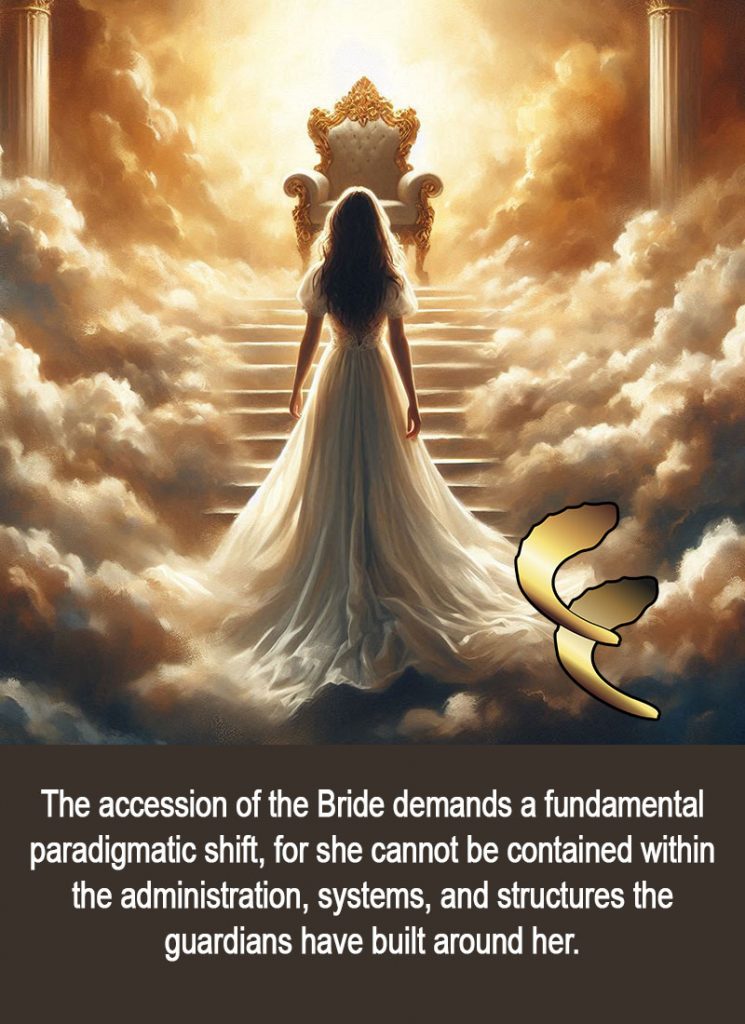
The accession of the Bride demands a fundamental paradigmatic shift, for she cannot remain within the administration, systems, and structures the guardians have built around her. She must be free from such impositions in order to make her final preparations and journey towards the Bridegroom.
Consequently, a tension exists between the guardians and the Bride—a tension that will, sooner or later, lead to confrontation. And make no mistake, the guardians will not release her easily. Yet, in the unfathomable wisdom and foresight of God, this was always understood. The need for an anointing to break her free had long been anticipated and provided for.
This is why the Shulamite responded so defiantly as she did:
“[The Shulamite] I [am] a wall, And my breasts like towers; Then I became in his eyes As one who found peace.” Song of Songs 8:10 NKJV
For too long she had tended her brothers’ vineyards, neglecting her own, and suffered as a consequence. Though undesirable, her situation had at least been tolerable—until love was awakened within her heart. And love changes everything. Now, her subjection to labour in her guardians’ vineyards under a tanning sun was no longer acceptable. She would risk everything for the one her soul loved.
Her brothers said she had no breasts, but as we discover, this was not the case at all. In her own words, “I am a wall, and my breasts like towers.” She concludes her admonishment with a much insightful affirmation: “Then I was in his eyes like one who found shalom.” HNV
The use of the word shalom adds weight and depth to her statement. Its root meaning is peace with God, especially in covenant relationship, but it also carries the sense of completeness, fullness, health, and prosperity. In other words, she was no longer dependent upon them, for she had found absolute acceptance and peace in the love of another. She knew this was how her Beloved saw her: “I was in His eyes like one who found shalom.” When He looked at her, He saw fullness and maturity—far from how her brothers saw her, with disdain and belittlement.
May this be our testimony also—to be in His eyes like one who has found shalom. To know with certainty the unrelenting love He has for us. To rest secure that when He looks at us, He sees what our guardians could never fully perceive or understand—the awakening of a Bridal love within our hearts that can neither be quenched nor contained.
It is time to arise.
It is time for the accession of the Bride into her destiny. This is what we will explore together in the remainer of this book.
“Set me as a seal upon your heart,
as a seal upon your arm,
for love is as strong as death,
jealousy as fierce as the grave.
Its flashes are flashes of fire,
the very flame of the LORD.
Many waters cannot quench love,
neither can floods drown it.
If a man offered for love
all the wealth of his house,
he would be utterly despised.”
Song of Songs 8:6-7 ESV
Selah
Principles
- A unique place awaits the Bride in the courts of Heaven. What happens next is her choice, her responsibility, her mandate.
- The Bride must contend for her rightful place.
- The accession of the Bride demands a fundamental paradigmatic shift, for she cannot remain within the administration, systems, and structures the guardians have built around her.
- Guardians will struggle to recognise the Bride in her maturity. Veiled by old paradigms and past familiarity, they will judge her by what she was, not who she has become. Her true beauty remains hidden from their gaze. She is unveiled for the eyes of the Bridegroom alone.
Scriptures
“Arise, shine; For your light has come! And the glory of the LORD is risen upon you.” Isaiah 60:1 NKJV
“For if you remain silent at this time, relief and deliverance for the Jews will arise from another place, but you and your father’s family will perish. And who knows but that you have come to your royal position for such a time as this?” Esther 4:14 NIV
Quotes
“The soul no longer concerns itself with exterior works or former occupations, for all its powers are now employed in loving God.”[7]
—St John of the Cross, The Ascent of Mount Carmel
“…On earth she [the church] is often in rags and tatters, stained and ugly, despised and persecuted. But one day, she will be seen for what she is, nothing less than the bride of Christ, ‘free from spots, wrinkles or any other disfigurement,’ holy and without blemish, beautiful and glorious. It is to this constructive end that Christ has been working…”—John Stott, The Message of Ephesians
Pause for Reflection
- In what ways might the Bride’s accession prepare her to intervene for the destiny of her nation?
- In what ways has the Bride been preoccupied with tending the vineyards of her guardians?
- What has the Bride allowed to grow wild or barren in her vineyard and how can she begin to restore what has been neglected?
- The Bride must discern the difference between honouring her past and being held back by it. What guardians might the Bride need to confront or release in order to step into her full authority?
[1] The name Hadassah, meaning myrtle, is richly symbolic for the Bride. Just as the myrtle is an evergreen, fragrant plant that flourishes even in challenging environments, so the life of Esther reflects steadfastness, beauty, and spiritual vitality under God’s care. In Scripture, the myrtle often represents righteousness and flourishing (Jeremiah 17:8), a fitting emblem for the Bride of Christ, who is nurtured and prepared by the Spirit for her Husband. Hadassah’s hidden identity and eventual emergence into royal authority mirror the Bride’s journey: growing in secret, yet positioned by God to act at the right moment to fulfil His purposes.
[2] “(5) Now there was a Jew in Susa the citadel whose name was Mordecai, the son of Jair, son of Shimei, son of Kish, a Benjaminite, (6) who had been carried away from Jerusalem among the captives carried away with Jeconiah king of Judah, whom Nebuchadnezzar king of Babylon had carried away. (7) He was bringing up Hadassah, that is Esther, the daughter of his uncle, for she had neither father nor mother. The young woman had a beautiful figure and was lovely to look at, and when her father and her mother died, Mordecai took her as his own daughter.” Esther 2:5-7 ESV
[3] “On the third day Esther put on her royal robes and stood in the inner court of the king’s palace, in front of the king’s quarters, while the king was sitting on his royal throne inside the throne room opposite the entrance to the palace.” Esther 5:1 ESV
[4] “And when the king saw Queen Esther standing in the court, she won favour in his sight, and he held out to Esther the golden sceptre that was in his hand. Then Esther approached and touched the tip of the sceptre.” Esther 5:2 ESV
[5] “When you build a new house, you shall make a parapet for your roof, that you may not bring the guilt of blood upon your house, if anyone should fall from it.” Deuteronomy 22:8 ESV
[6] Genesis 24
[7] St John of the Cross understood that true bridal maturity is marked by a holy dissatisfaction with substitutes. Commenting on the Bride’s cry in The Spiritual Canticle, he writes, “The soul is no longer content with any created thing, nor with spiritual sweetness; it must possess the Beloved Himself.” This marks the moment when guardianship comes to an end.